-
Thread 처리 시간-22.03.30고급자바 2022. 3. 30. 11:18728x90
스레드의 수행시간 체크해 보기
public class T03_ThreadTest {
	public static void main(String[] args) {
		// 스레드의 수행시간 체크해 보기

				Thread th = new Thread(new MyRunner());

				/*
				   UTC(Universal Time Coordinated 협정 세계 표준시)를 사용하여 1970년 1월 1일
				   0시 0분 0초를 기준으로 경과한 시간을 밀리세컨드 단위로 나타낸다.
				*/
				long startTime = System.currentTimeMillis();

				th.start(); // 스레드 작업 시작

				try {
					th.join();  // 현재 실행 중인 스레드에서 작업중인 스레드(지금은 th스레드)가 종료될 때까지 기다린다. run()종료되는 시점에 기다림이풀림
				} catch (InterruptedException e) {
					e.printStackTrace();
				}

				long endTime = System.currentTimeMillis();

				System.out.println("경과시간 : " + (endTime - startTime));
			}
		}
1~1000000000 까지의 합계를 구하는 스레드 클래스
class MyRunner implements Runnable {

			@Override
			public void run() {
				long sum = 0;
				for(int i = 0; i<=1000000000; i++) {
					sum += i;
				}
				System.out.println("합계 : " + sum);
			}
		}
1~20억 까지의 합계를 구하는데 걸린 시간 체크하기
전체 합계를 구하는 작업을 단독으로 했을 때(1개의 스레드를 사용했을 때)와
여러 스레드로 분할해서 작업할 때의 시간을 확인해 보자단독으로 처리했을 때(시간처리단위: 밀리세컨드)
public class T04_ThreadTest {
	public static void main(String[] args) {

		// 단독으로 처리했을 때(단위: 밀리세컨드)
				SumThread sm = new SumThread(1L, 2000000000L);

				long startTime = System.currentTimeMillis();

				sm.start();

				try {
					sm.join();
				}catch(InterruptedException ex) {
					ex.printStackTrace();
				}

				long endTime = System.currentTimeMillis();

				System.out.println("단독으로 처리할 때의 처리 시간 : " + (endTime - startTime));
				System.out.println("\n\n");
여러 스레드가 협력해서 처리 할때
SumThread[] sumThs = new SumThread[] {
					new SumThread(1L,            500000000L),
					new SumThread( 500000001L,  1000000000L),
					new SumThread(1000000001L,  1500000000L),
					new SumThread(1500000001L,  2000000000L)
				};

				startTime = System.currentTimeMillis();

				for(int i=0; i<sumThs.length; i++) {
					sumThs[i].start();
				}

				for(SumThread th : sumThs) {
					try {
						th.join();
					} catch (InterruptedException e) {
						e.printStackTrace();
					}
				}

				endTime = System.currentTimeMillis();

				System.out.println("협력해서 처리 했을때의 처리 시간 : "
									+ (endTime - startTime));
			}
		}
더해주는 Thread클래스
class SumThread extends Thread {
			private long max, min;

			public SumThread(long min, long max) {
				this.min = min;
				this.max = max;
			}

			@Override
			public void run() {
				long sum = 0L;
				for(long i = min; i <= max; i++) {
					sum += i;
				}
				System.out.println(min + " ~ " + max + "까지의 합 : " + sum);
			}
		}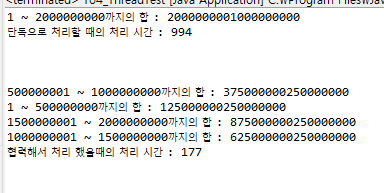

코어 개수에 따라 멀티스레드 활용할 수 있다.
CPU가 한개라면 나눠서 하는것이 비 효율적일 수도 있음
EX) ①은 비효율적 ②오히려 얘가 더 빠를 수도 있음
 728x90
'고급자바' 카테고리의 다른 글
ThreadPriority, Daemon Thread-22.03.30 (0) 2022.03.30 단일, 멀티 Thread-22.03.30 (0) 2022.03.30 ThreadTest-22.03.29 (0) 2022.03.29 Annotation,Reflection-22.03.29 (0) 2022.03.29 가변형 인수,enum-22.03.29 (0) 2022.03.29